Big Walk Peg Puzzle — Blue Room Pegboard Solved
Last verified: August 12, 2026 · A dedicated deep-dive on the starting Blue Room peg puzzle.
The peg puzzle is most groups' first real communication test in Big Walk — and the one that teaches you the describing skill every later puzzle needs. Here's everything about it: where it is, how the room works, a step-by-step solve, tactics for bigger groups, and the shape names that save you minutes.
Where It Is
A small blue house on the left side of the starting valley. Leave the tutorial grounds, hug the left edge of the path, and keep climbing the mountain on the left — the house sits just left of the green platform on the mountainside, and it's visible from the telescope platform across the valley. Approximate map coordinates: 3660, 1295 (read off the map room's grid). If you overshoot to the green scaffolding, you've walked a few steps past the door.
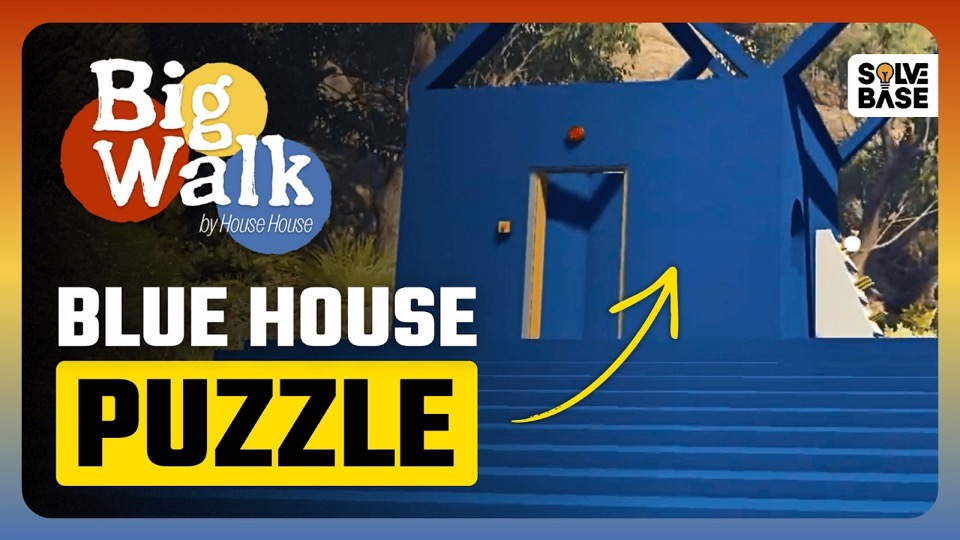
The Blue House peg puzzle, tucked into the left side of the starting valley.
How the Room Works
Two players minimum. Outside the house sit a rack of nine wooden symbol pieces and a panel with five empty slots (the "pegboard"). Inside are five black screens. One player steps in; the outside player presses the button by the door and the door slides down, sealing them inside. With the door closed, the screens show five symbols — visible only to the sealed player. They read them out over voice (which passes through the window fine), and the outside player finds the matching pieces and places them in the five slots, left to right.
Big Walk's core loop: describe, place, confirm. The peg puzzle is the gentlest version of it.
Step-by-Step Solution (2 Players)
- Pick roles. Reader goes inside; Placer stays out.
- Name the shapes first. Point at the pieces on the rack and agree on names before anyone locks the door.
- Lock in. Reader enters; Placer presses the door button. The door closes and the screens light up.
- Read one slot at a time, left to right: "Slot one is the asterisk, slot two is the S…"
- Find and confirm. Placer picks the matching piece from the rack, holds it up to the window (press Q or E, or turn so the Reader can see it on your back) and places it.
- Watch for the glow. A correctly placed piece glows — instant confirmation. No glow means wrong piece; swap it.
- Submit. When all five slots match, press the button beside the board. Confetti falls and the red gourd drops from the clamp overhead. Grab it and go.
3-4 Player Tactics
The puzzle itself always needs exactly one player inside; extra players just make it faster:
- 3 players: one inside, one placing, one verifying — holding candidate pieces up to the window for the Reader to approve, then ferrying the gourd to the bridge panel afterwards.
- 4 players: split the five slots. Each outside player memorizes one or two symbols and their positions, and grabs those pieces first; the Reader calls them out one at a time.
- Bigger groups (up to 12): pull every piece off the rack and lay them out on the ground in order — everyone can see the whole set at once, and players each "own" one or two slots. This works, but only if one person talks at a time (see mistakes).
Naming the Shapes
The pieces are wooden with white symbols. Names groups actually use: asterisk, six, slash, line, star, triangle, S, lowercase E, Y, spiral (or "tornado"/"Naruto sign"), swirl, squiggly, snowman (three stacked balls), three dots in a vertical line, circle on a slanted line (or "ball on a ramp"), firework (a line with spokes), stop sign. Always say position + name ("slot three: snowman"), never "the weird one."
Common Mistakes
- Opening the door mid-round. The symbols vanish and the pattern rerolls — you have to re-describe everything. Keep the door shut until all five are placed.
- Describing all five at once. Go slot by slot; memory fades fast.
- Relaying descriptions through another player. It becomes a telephone game — 12-player runs regularly garble "three dots in a vertical line" into chaos. Direct Reader-to-Placer only.
- Dropping pieces. Dropped pieces land handle-side up and can't be read through the window. Hold them up (Q/E) or place them.
- Vague names. "The one with the thing" wastes a minute per piece. Agree on names before locking the door.
- Confusing it with the Turnstile House near the Blue Tower (3505, 1960) — same nine-pieces/five-slots idea, different building, different reward chain.
Reward
The red gourd — one of the four gourd collectibles (some groups call them pears, eggy things, or "babies") needed for the drawbridge. Carry it to the panel at the bridge, hold the matching button while a partner drops it into its slot, and repeat for all four; the key appears, runs through five key cutters, and the drawbridge lowers.
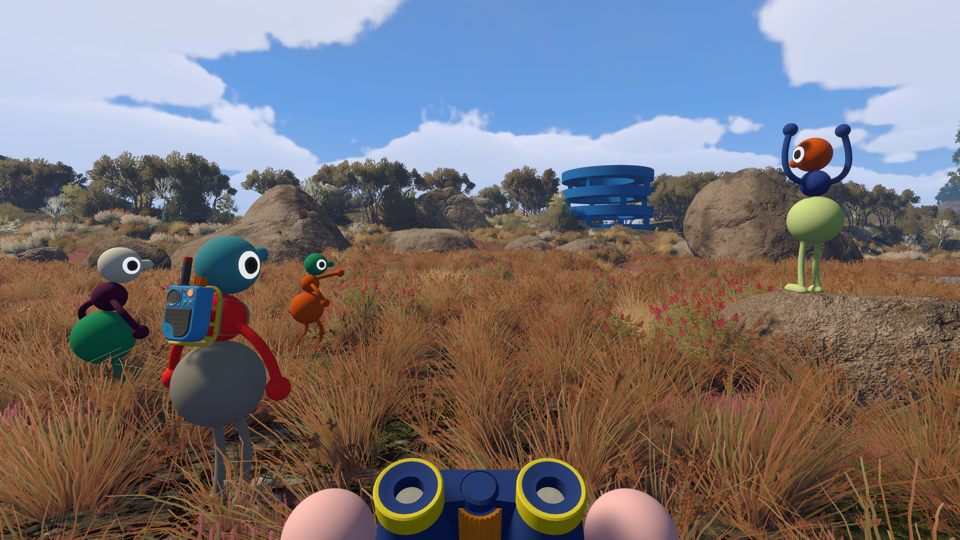
Official game screenshot — the peg puzzle is one of four opening puzzles that build the drawbridge key.
Fun Facts
- Voice passes through the window, so no walkie-talkies are needed here (they work, though).
- It's the game's gentlest introduction to the "describe the pattern" family — the same skill returns harder at the Green Room, the Turnstile House, and the voice-blocked Black Tower rooms.
- The pattern is randomized every session, so screenshots are useless — it's always a fresh listening exercise.
- It's the easiest of the four starting puzzles to brute-force if your naming collapses: place pieces one at a time and let the glow tell you which five of the nine are in play.